Most men cannot immediately explain why one suit feels different from another. They sense it, in the way a jacket settles onto the shoulders without effort, in the way it moves when they reach for something, in the quiet ease of wearing something that was never mass produced. But the actual reasons stay hidden, buried inside the garment where nobody thinks to look.
That is by design. The things that separate a custom suit from an off-the-rack one are not meant to announce themselves. They are meant to be felt, worn, and understood over time. Here is what to look for.
The Fit
Store-bought guesses at your body. Custom is built around it.
A store-bought suit is built for an average body, then adjusted a little at the counter. The shoulders, chest, and sleeve length are already decided before you try it on. A tailor can take in the waist or shorten a sleeve, but nobody can rebuild a shoulder that was never shaped for you in the first place.
A custom suit starts the other way around. Your shoulders, your chest, your exact waist. Nothing is guessed. The jacket is built from your body outward, not adjusted from someone else's inward.
The Fabric
Store-bought hands you what's on the rack. Custom hands you the choice.
In a store, you choose from whatever happens to be hanging in your size that day. The mill, the weight, the weave, none of it was decided with you in mind.
In a custom suit, you choose the actual cloth yourself, from swatch books that include fine wool most stores never carry. Want something heavier for winter or lighter for summer. You pick it.
The Lining
Store-bought decides for you. Custom lets you decide.
A store-bought jacket comes with one lining already sewn in. What you see is what you get, and it says nothing about you.
A custom jacket lets you choose the lining color and material, down to a subtle monogram stitched inside where only you will see it. It is a small detail. It is also the first sign that the suit was made for one person, and that person is you.
The Lapel
Store-bought picks one style for everyone. Custom picks the one that suits you.
Off the rack, there is one lapel style, decided by whoever manufactured the suit. Notch, peak, or shawl, wide or narrow, it was chosen for the average shoulder, not yours.
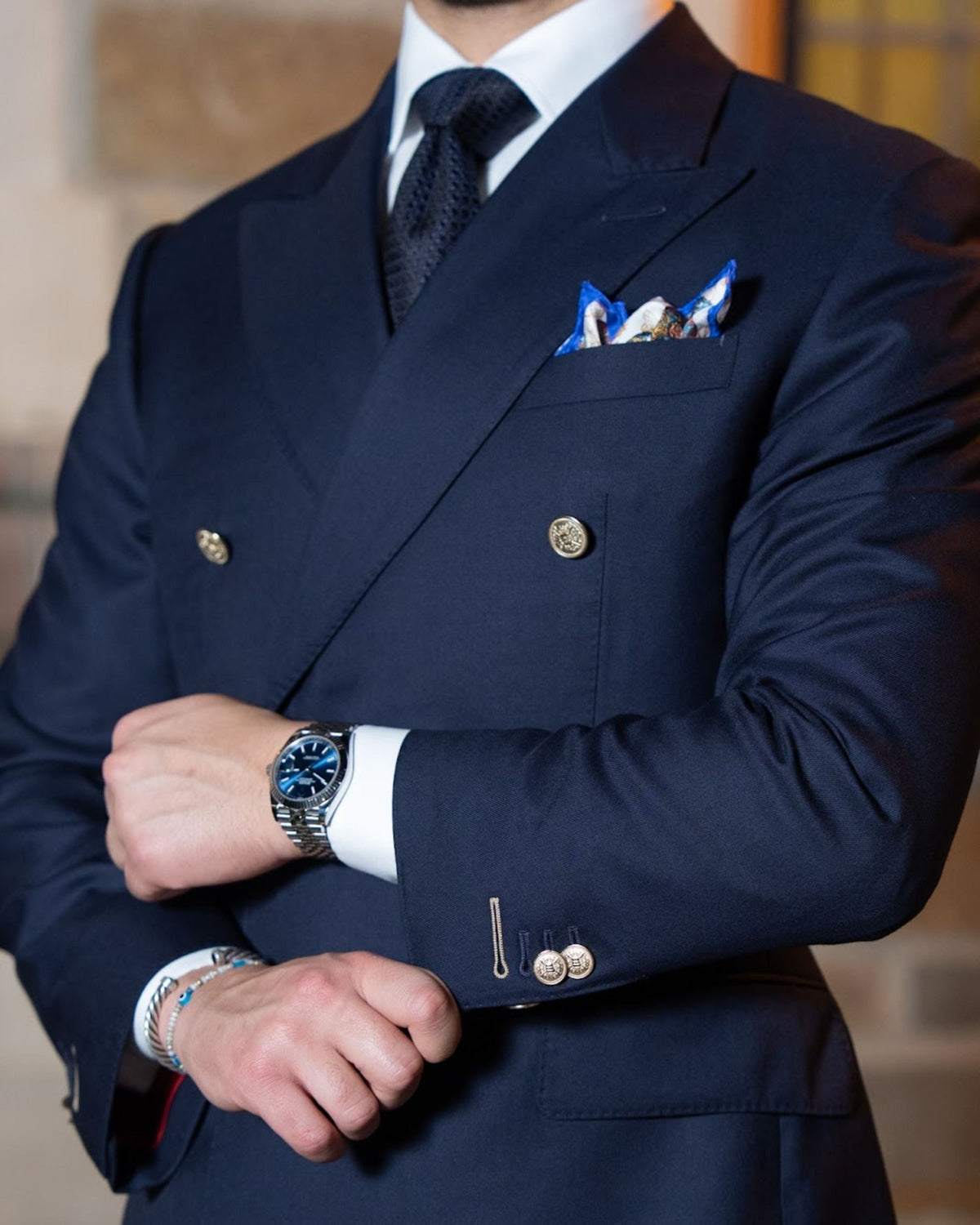
Custom means you choose the lapel that actually works with your build. A wider lapel flatters some men and overwhelms others. The right one is not a guess. It is a decision made for your frame specifically.
The Waist and Silhouette
Store-bought follows a size chart. Custom follows your shape.
A store-bought suit is cut straight or slightly tapered, based on a size chart built for thousands of different bodies at once.
A custom suit is shaped to your actual waist and torso. The jacket follows your shape instead of hanging loose in some places and pulling tight in others.
The Buttons and the Details
Store-bought fakes the details. Custom makes them real.
Store-bought suits use standard buttons and decorative buttonholes on the sleeve, stitched shut and never meant to open.
A custom suit can include real working buttonholes, along with your choice of button material and placement. Small details. They are also the difference between a suit that looks made for you and one that only looks like it was.
The Long Fit
Store-bought ends at the sale. Custom stays with you.
Once a store-bought suit is altered, that is the end of the road. If your body changes, you start over, either with more alterations or an entirely new suit.
With a custom suit, your pattern is kept on file. If your weight or build shifts down the line, we work from your original measurements instead of starting from nothing.
The Sum of the Details
No single detail here defines a custom suit on its own. It is the combination, the shoulders shaped to your body, the fabric chosen by hand, the lapel selected for your frame, the lining that quietly says this was made for one person, that produces something a store simply cannot sell you off a rack.
A well-made suit does not need to announce itself. It is felt by the person wearing it before anyone else notices a thing.
What to Look For
- Press the shoulder of the jacket and watch how it settles. It should sit naturally, without pulling or gapping.
- Check the sleeve buttons. If they actually unbutton, that is a sign of real craftsmanship.
- Ask where the fabric came from. A clear answer is a good sign.
- Look inside the jacket at the lining. Something chosen, not just included.
- Move your arm and turn your shoulder. The jacket should move with you, not against you.
The decision to build a suit with Suit & Thread is a decision to feel these details for yourself, not just read about them.
We would be glad to show you the difference in person.